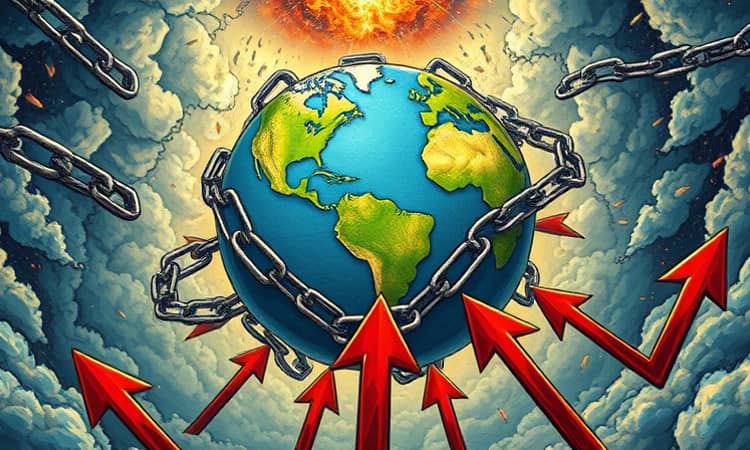
In an interconnected world where faith in government debt anchors global finance, the specter of a sovereign default can send shockwaves through every facet of economic life. This article delves into the staggering depth of such an event, illuminating how a breach of trust at the highest level would ripple outward through markets, households, and international systems. We explore the figures, scenarios, and human stories underlying this looming risk.
By examining both immediate fallout and long-term aftermath, readers will gain a comprehensive view of why avoiding default is critical to preserve stability and growth. The data and analysis presented here draw on historical precedents and authoritative forecasts to paint a vivid portrait of what could unfold.
Economic Shockwaves and GDP Decline
When a government fails to meet its debt obligations, the damage to gross domestic product is swift and severe. According to Moody’s, a sustained default could drive a 4.6% throughout the end of 2023 contraction in real GDP. The White House Council of Economic Advisers warns of an even darker scenario: over a 6% shrinkage of the economy if the impasse drags on.
Historical studies of 221 sovereign defaults between 1815 and 2020 show that defaulting nations fall behind their peers by a cumulative 8.5% of GDP per capita within three years. A decade later, output per person remains nearly 20% below that of non-defaulting counterparts. These figures underscore how the long-lived scars on growth may persist long after headline metrics recover.
Recession and Financial Crisis
Default plunges an economy into a recession rivaling the global financial crisis. Rising funding costs choke off credit, while banks and markets reel from skyrocketing risk premiums. Even short-lived breaches can trigger a disorderly selloff, with prime money markets freezing and liquidity evaporating.
In a typical policy response, central banks and governments would deploy counter-cyclical measures to cushion the blow. However, a defaulting government is stripped of that ammunition. With its creditworthiness in tatters, fiscal support becomes infeasible, leaving households and businesses exposed to the full force of the downturn.
Stock Market Collapse
Equity markets would not escape unscathed. The White House report estimates a 45% stock market decline under a protracted default scenario. Retirement savings and pension funds would be decimated, and consumer confidence would crater in tandem with stock indices.
Moody’s projects as much as $10 trillion in U.S. household wealth wiped out, a blow that reaches far beyond Wall Street. European and Asian markets would also suffer, as the dollar weakens and risk aversion spreads across global exchanges.
Unemployment and Labor Market Impact
Job losses would mount with alarming speed. Moody’s analysis suggests that a cascading default could eliminate nearly 8 million jobs, pushing the unemployment rate above 8%. Even a brief breach could cost 1.5 to 2 million jobs, nudging unemployment up to 5% from its current 3.5%.
Industries reliant on credit—construction, manufacturing, and services—would be the hardest hit. Hiring freezes and layoffs become commonplace, and displaced workers face a more challenging labor market without government support programs.
Rising Borrowing Costs and Interest Rates
A default strips Treasury securities of their unrivaled safety, sending borrowing costs through the roof. Fitch Ratings would likely reclassify U.S. debt as "RD" (Restricted Default), slashing bond ratings and raising yields across the curve.
Mortgage rates could spike above 8.4%, according to Zillow, and home sales drop nearly 23% amid tighter credit. A Brookings analysis estimates that lost liquidity and safety in the Treasury market could translate into over $750 billion in higher federal borrowing costs over the next decade—burdens borne by future generations.
Timeline and Severity Distinctions
The depth of the fallout hinges on how long the default persists. Below is a summary of key impacts under brief versus protracted scenarios:
Social and Humanitarian Costs
The suffering extends beyond economic data. Historical evidence reveals that sovereign defaults inflict deep social wounds, with effects on health, poverty, and well-being that linger for years.
- Infant mortality rates increase due to reduced healthcare funding and nutrition shortages.
- Life expectancy can stagnate or decline amid severe austerity.
- Poverty headcounts swell as unemployment spikes and safety nets falter.
- Calorie supply per person shrinks, undermining public health.
Global Implications
A U.S. default would ripple through global trade, straining export markets and supply chains. The dollar’s role as the world’s reserve currency would be tarnished, prompting volatile swings against other currencies and reducing global liquidity.
Investors would diversify away from dollar assets, reallocating portfolios to perceived safer havens. Emerging markets, often reliant on dollar-denominated financing, would face higher funding costs and capital outflows, deepening financial stress abroad.
Historical Context and the Path Forward
Despite periodic brinkmanship over the debt ceiling, the United States has avoided default since its founding. Economists across the spectrum agree that a breach would be an "entirely-avoidable economic catastrophe," inflicting damage that could persist for decades.
Preventing default requires timely legislative action, prudent fiscal management, and a commitment to uphold trust in sovereign debt. Policymakers must recognize that the costs of inaction far outweigh the challenges of compromise.
By understanding the full spectrum of consequences—from immediate market turmoil to long-term social distress—citizens and leaders alike can appreciate why safeguarding creditworthiness is not just a technical issue, but a cornerstone of shared prosperity and global stability.